A Lesson Learned at Sea
Published Friday, March 27th 2026This article is long overdue.
Several months ago, I decided to take a cruise with friends and cut costs wherever possible. I wanted the lowest fare I could find. That decision led to one of the more memorable lessons I’ve learned at sea.
The cabin category was called an “Upper/Lower.” If you’ve ever stayed in a standard inside cabin, imagine splitting it in half. That’s essentially what this was.
Before I get back to the room, let me give you some context on the ship itself.
We sailed on the Carnival Dream. She’s an older ship, but still well maintained and very much in line with the Carnival experience. Onboard staples included Guy’s Burger Joint, Blue Iguana Cantina, the Pizza Pirate, and Pig & Anchor Smokehouse — all excellent options and, frankly, where we spent most of our time eating.
The main dining room and buffet are included in your cruise fare, as expected. Neither stood out as exceptional, though there was one bright spot inside the buffet: the omelet station at breakfast. The line was consistently long, but the cooks moved quickly and delivered consistently good made-to-order eggs. It became a reliable morning stop.
Entertainment followed the traditional Carnival formula — high-energy singers and dancers (not particularly my preference), a solid comedy club lineup, and the classic audience participation shows. One evening featured a game-show-style event similar to the “Newlywed Game,” where the youngest married couple, the longest married couple, and one in between answer hilariously awkward questions. It’s lighthearted and draws a crowd.
For my wife and me, however, the true refuge was the thermal spa. Each day we retreated there — heated pools, saunas, heated loungers, and most importantly, quiet. That space became our reset button. It’s also what made our cabin situation manageable.
Now, back to the Upper/Lower.
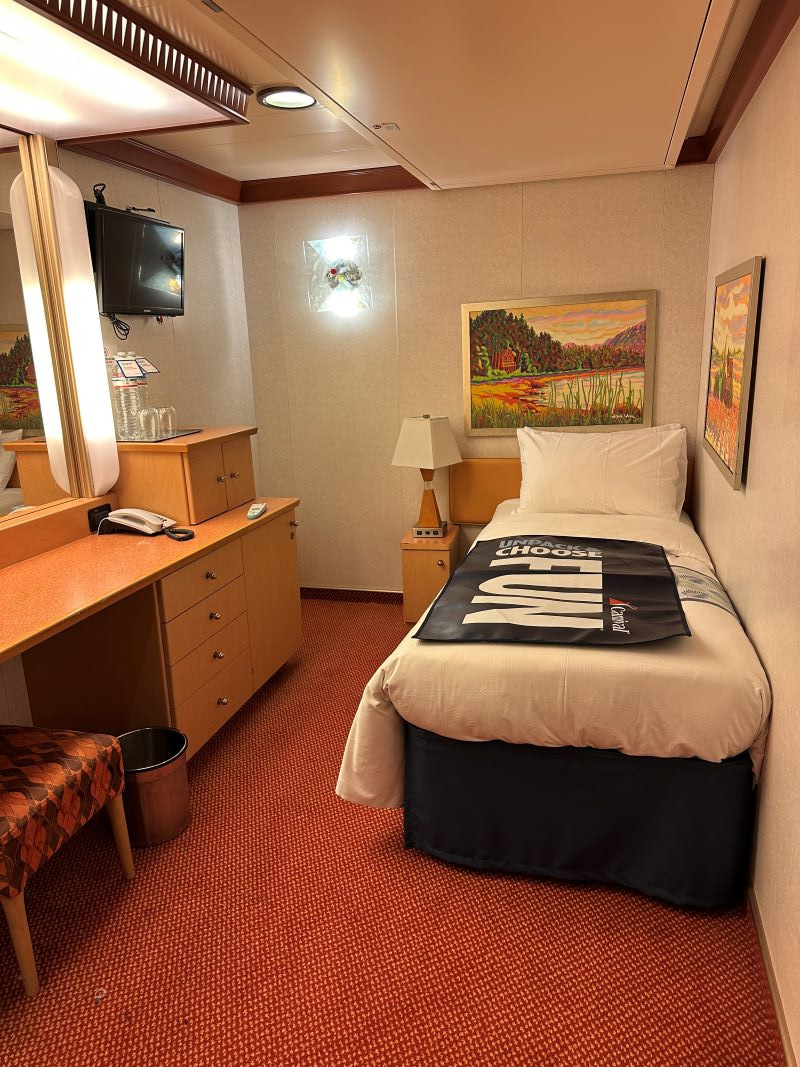
When you opened the door, you were immediately face-to-face with the opposite wall just a few feet away. The total length of the room was roughly ten feet. The width? Perhaps six or seven feet. There was no chair, no sitting area — just a single twin bed along one wall.
And here’s where the surprise came in.
This cabin was sold for two people. When my wife and I entered and saw only one narrow twin bed, we genuinely paused. Where does the second person sleep?
The answer: a bunk that folds down from the ceiling.
Each evening the room steward would lower it into place. Each morning it would be cranked back up — likely because no one wants to spend more time in that space than necessary. The upper bunk rested on a steel frame with a mattress roughly an inch and a half thick. Calling it minimal would be generous.
Across from the lower bed sat a small dresser with a mounted flat-screen television above it. The room was so narrow that you could sit sideways on the bed, lean against the wall, and place your feet on the dresser without stretching.
For a solo traveler? It could work. For a young couple with resilient backs? Possibly manageable. For us? Once was enough.
And yet — here’s the important part — it was still a great trip.
I’ve said this before and I’ll say it again: I’ve never been on a bad cruise. Even with the cabin constraints, we enjoyed our time with friends, the food venues we liked, the spa, and the overall experience.
But I learned something valuable.
Sometimes “as cheap as possible” costs more in comfort than it saves in dollars. I won’t book an Upper/Lower again — and now I can share that experience with clients who are tempted to do the same.
Experience is a powerful teacher. Sometimes it just comes with a thin mattress.
Leave a Reply
indicates a required field